
By Sandra Bargeron, PA-C, CAA. Physician Assistant-Certified and Certified Anesthesiologist Assistant, writing from 22 years of clinical experience in the operating room.
Published: July 2026 | Reviewed: July 2026
Key takeaways
- In 1999, a hospital program cut delirium in older patients by about 40 percent using six simple, non-drug steps.
- The steps protect orientation, sleep, movement, vision, hearing, and hydration.
- Most patients still do not receive this protection, because no single person or department owns it.
- Research now shows a patient’s brain health before surgery matters more than the type of anesthesia.
- You can measure your neurologic reserve before surgery with the NSRI™ and strengthen what you can change.
Cognitive decline after surgery is a real and measurable problem for older adults. Recent studies still find that roughly one in four older patients show some cognitive decline about a week after an operation. The surprising part is that we have known how to lower this risk since 1999.

This article explains what works, why it is still not standard, the six factors you can influence, the questions to ask your surgical team, and how to measure your own starting point before surgery.
A nearly 40 Percent Drop in Delirium, With No New Drug
In 1999, researchers published a study that should have changed surgery. In older hospitalized patients, they lowered the rate of delirium, which is sudden confusion by 34%. Fewer episodes. Fewer days lost. All of this with only postoperative intervention. No pre-surgery preparation.
They did not use a new medicine or machine. They protected six human needs: orientation and mental engagement, sleep, movement, vision, hearing, and hydration.
The savings were real, too. Patients in the program had lower hospital charges. Later programs built on the same model saved roughly 1,600 to 3,800 dollars per patient. One community hospital that kept the program going reported a return of more than 7.3 million dollars in a single year, from preventing complications and from freeing up beds sooner.
Delirium matters far beyond the hospital stay. It is linked to longer recovery, loss of independence, and a higher chance of lasting cognitive problems. Preventing it is one of the most powerful things medicine can do for an older patient. And most of the tools to prevent it are not high-tech.
Why Proven Prevention Still Is Not Routine
If this works, why do most patients still not get it, more than 27 years later? It is not because doctors ignore the evidence. The real reason is how hospitals are built.
Who Owns Sleep, Orientation, and Mobility?
In a hospital, a medicine has an order and a billing code. A lab test has a workflow. A procedure has an owner.
But who owns sleep? Who makes sure the hearing aids are in, the glasses are on, the patient is walking, and the mind is engaged? The surgeon? The nurse? The anesthetist? The family?
The answer is everyone in theory and no one in practice. Preventing delirium takes screening, teamwork, and follow through across many departments. Our system pays more clearly for treating a problem than for preventing it.

That is the infrastructure gap. It is not that we lack the knowledge. We lack a reliable way to deliver it.
The Six Factors That Protect the Brain, and What You Can Do About Each

Here is the part most patients never hear before surgery. The six factors that lowered delirium are things you and your family can help protect. You do not need permission to support them.

Orientation and mental engagement
A stressed brain does better when it stays anchored to the world. Bring a clock and a calendar the patient can see. Talk about the day, the date, and where they are. Keep familiar photos nearby. Ask the care team to limit nighttime interruptions that break the day and night rhythm.
Sleep

Poor sleep is one of the strongest triggers for confusion after surgery. Ask about grouping care so the patient is not woken every hour. Bring earplugs and an eye mask. Keep the room dark and quiet at night and bright during the day.
Movement

Lying still for days weakens the body and the brain. Ask when it is safe to sit up, stand, and walk, then help make it happen. Even short, frequent movement helps.
Vision

A patient who cannot see well is more likely to become disoriented. Make sure glasses come to the hospital, stay within reach, and are actually used. Label the case with the patient’s name.
Hearing

The same is true for hearing. Bring hearing aids, fresh batteries, and the charger. Confusion is often just a person who cannot hear what is happening to them.
Hydration

Dehydration can tip an older brain into confusion. Ask the team about the fluid plan, and help the patient drink when it is allowed.
None of these require a prescription. All of them require someone paying attention. Often, that someone is you.
The Science Kept Moving Toward One Answer

While the delivery problem went unsolved, the science advanced:
- 1998: A major study confirmed that cognitive decline after surgery is real and measurable.
- 2018: Experts agreed on shared terms to describe these changes.
- 2019: Protecting the brain during surgery became a formal priority in anesthesiology.
- 2021 and 2022: Two large trials tested whether switching from general to spinal or regional anesthesia would lower delirium. It did not.
The Answer Is Your Starting Point

A closer look at the data pointed to one clear idea. The type of anesthesia was not the main driver. The patient’s brain health before surgery was. A person’s baseline cognition more than doubled their risk of delirium.
In plain terms: your starting point matters more than the drug. And unlike the anesthetic, your starting point is something you can understand and strengthen before surgery.
What Is Neurologic Reserve?

Neurologic reserve is your brain’s capacity to absorb stress and recover from it. Surgery is a stress. So is anesthesia, blood loss, inflammation, and a night of broken sleep in a strange room. A brain with more reserve can take that hit and bounce back. A brain with less reserve is more likely to slip into confusion and take longer to recover.
Think of it like a savings account. The more you have built up before a large withdrawal, the less the withdrawal hurts. Reserve is shaped by many things, including sleep, physical activity, medications, other health conditions, and how well your senses are supported. Some of those you cannot change quickly. Many of them you can.
Questions to Ask Your Surgical Team Before Surgery

You have more say than you may realize. Bring these questions to your pre-surgery visit:
- Am I at higher risk for confusion or memory changes after this surgery?
- What is the plan to protect my sleep in the hospital?
- How soon can I get up and move after surgery?
- Will my glasses and hearing aids stay with me before and after the procedure?
- What is being done to keep me hydrated and oriented?
- Are any of my current medications linked to confusion, and should any be adjusted before surgery?
- Who on the team is responsible for my brain health during this stay?
That last question is the most important one. Asking it out loud makes the invisible work visible. It tells the team that this matters to you, and it often changes what happens next.
From 22 Years at the Head of the Table

I spent 22 years in operating rooms. First assisting the surgery as a PA. Then at the head of the table as an anesthetist, managing the brain through it. I have watched what surgery does to people from both sides.
Here is what I learned. The moment that shapes a patient’s recovery is often not on the operating table at all. It is the weeks before, when no one is measuring the one thing that matters most: what the patient brings in with them. We study the outcome carefully. We rarely prepare the starting point. That gap is the reason I built a way to measure it.
What You Can Do Before Your Surgery

You do not have to wait for the system to catch up. Before surgery, you can learn your starting point and strengthen what can be changed.
That is why I created the Neurologic Stress & Recovery Index™ (NSRI™). The NSRI™ does not predict or diagnose. It quantifies your neurologic reserve and identifies what you can strengthen while there is still time.
The assessment is free. The report shows you where you stand and what to do about it.
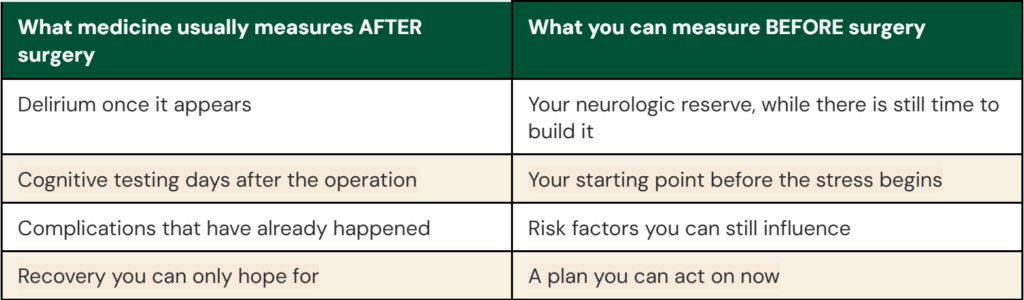
Two Different Windows
Frequently Asked Questions
How common is cognitive decline after surgery?
It is common in older adults. Recent studies still find that roughly one in four older surgical patients show measurable cognitive decline about one week after surgery. Rates vary by the type of surgery and the patient’s health.
Who is most at risk for cognitive decline after surgery?
Older adults are at higher risk, especially those with lower baseline cognition before surgery, existing memory concerns, frailty, poor sleep, vision or hearing loss, or several medications. A person’s brain health before surgery is one of the strongest signals.
Can cognitive decline after surgery be prevented?
Risk can be lowered. Since 1999, hospital programs that protect orientation, sleep, movement, vision, hearing, and hydration have cut delirium by about 40 percent. Preparing your brain before surgery can also help.
How long does cognitive decline after surgery last?
For many patients it is temporary and improves over weeks. For some, especially after delirium, changes can last longer. This is why prevention and a strong starting point matter so much.
Does the type of anesthesia affect cognitive decline?
Large trials in 2021 and 2022 found that switching from general anesthesia to spinal or regional anesthesia did not meaningfully reduce delirium. A patient’s brain health before surgery mattered more than the anesthetic.
What is neurologic reserve?
Neurologic reserve is your brain’s capacity to absorb stress and recover from it, including the stress of surgery. A higher reserve is linked to better recovery.
What is the NSRI™?
The Neurologic Stress & Recovery Index™ (NSRI™) is a pre-surgical assessment created by Sandra Bargeron, PA-C, CAA. It quantifies your neurologic reserve and identifies what can be strengthened before surgery. It does not predict or diagnose.
What is postoperative delirium?
Postoperative delirium is a sudden state of confusion that can occur after surgery, especially in older adults. It can affect attention, memory, and awareness, and it is linked to longer recovery.
About the author
Sandra Bargeron, PA-C, CAA, is the founder of Beyond Brain Health™ and the creator of the Neurologic Stress & Recovery Index™ (NSRI™). She is a Physician Assistant-Certified and a Certified Anesthesiologist Assistant with more than 22 years of clinical experience, including 16 years of direct anesthesia practice across more than 10,000 cases. [Link: About Sandra]
Key sources
Inouye SK, et al. A multicomponent intervention to prevent delirium in hospitalized older patients. N Engl J Med. 1999.
Hshieh TT, et al. Hospital Elder Life Program: systematic review and meta-analysis of effectiveness. Am J Geriatr Psychiatry. 2018.
Rubin FH, et al. Sustainability and scalability of the Hospital Elder Life Program at a community hospital. J Am Geriatr Soc. 2011.
Evered L, et al. Recommendations for the nomenclature of cognitive change associated with anaesthesia and surgery. 2018.
Mahanna-Gabrielli E, et al. State of the clinical science of perioperative brain health (ASA Brain Health Initiative). 2019.
REGAIN trial. Spinal anesthesia or general anesthesia for hip fracture. N Engl J Med. 2021.
RAGA trial. Regional versus general anesthesia and postoperative delirium. JAMA. 2022.